- AcaiveTime:2025-12-23 ~
- Time:
- 2025-12-23
- Unit:
- Dept. of Marine Science
- Content:
-
(Forwarded from Youth Daily reporter Sun Jianping / Kaohsiung report)
To showcase the government's collaboration with academic and research institutions in promoting marine technology and actively building Taiwan's independent "maritime security awareness capabilities" and "maritime governance technology chain," the Ocean Affairs Council held a "Marine Technology Project Results Presentation" today (22nd) at the Kaohsiung Exhibition Center. The presentation showcased Taiwan's latest research achievements in areas such as maritime security, smart monitoring, sensing technology, pollution control, marine conservation technology, and surface and underwater vehicle technology. Faculty and students from the Department of Marine Science at the Naval Academy also attended the event to broaden their academic research horizons, understand the latest research and development capabilities in marine technology, and inspire future applications and creativity in national defense.
The press conference brought together industry, government, academia, and research teams that have participated in marine technology projects over the years, attracting nearly 200 researchers and application units. In his opening remarks, Liu Kuo-lie, Chief Secretary of the Ocean Affairs Council, stated that marine technology is a new foundation for national governance and a new focus of international competition. Taiwan is at the forefront of this global wave. Since the launch of the "Marine Technology Project," the achievements of various expert research teams have demonstrated the growth of Taiwan's marine technology capabilities and the leap in governance capacity.
Liu Kuo-lie emphasized that marine technology is not just about parameters, models, platforms, or vehicles; its mission is to help the Taiwanese people understand that the ocean is not a boundary, but a shared future. For Taiwan to become a true maritime nation, it must simultaneously possess technological strength, governance capabilities, and the knowledge to understand the ocean.
This conference showcased the fruitful results of the "Marine Technology Project" implemented in 2024 and 2025. 28 presentations were given by funded and collaborating teams, covering areas such as marine ecological conservation and blue carbon recovery, marine pollution prevention and environmental monitoring, smart unmanned vehicles and underwater acoustic monitoring, maritime communications, and the Internet of Things (IoT). The aim was to promote the innovative application of marine technology in Taiwan, enhance maritime safety monitoring and sustainable governance capabilities, and strengthen industry-government-academia-research cooperation and technology integration through interdisciplinary dialogue and exchange of practical experience, thus shaping a more comprehensive marine technology development strategy for Taiwan.
Furthermore, to deepen international exchange and introduce forward-looking perspectives, the conference specially invited Professors Stephen R. Nagy and James Hartman from the Yokosuka Council on Asia-Pacific Studies to deliver keynote speeches, focusing on Maritime Security Awareness (MDA) and technological deployment under regional cooperation.
Dr. Stephen R. Nagy focused on "dark ship" detection, explaining how integrating satellite SAR, AIS analysis, and artificial intelligence can enhance real-time monitoring and early warning capabilities. He pointed out that data sharing and system interoperability are key to building a resilient monitoring network. James Hartman approached the topic from the perspectives of naval capabilities and maritime policy, analyzing the challenges of information collaboration and capability complementarity in Northeast Asia. He also explored how next-generation technologies such as space and commercial surveillance, unmanned vehicles, and data processing can promote more efficient regional maritime cooperation.
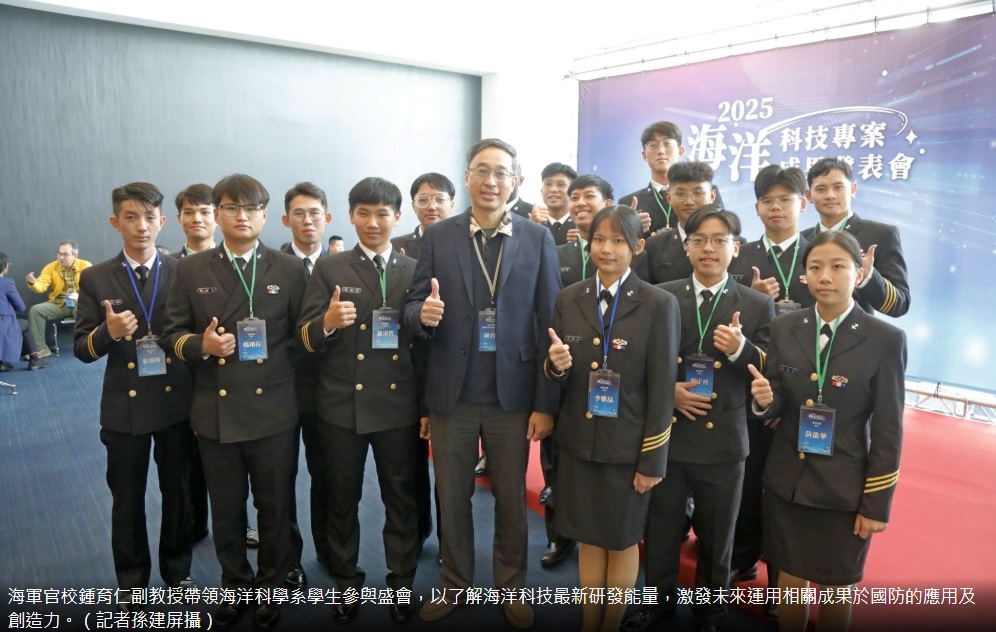
Associate Professor Chung Yu-Jen of the Naval Academy led students from the Department of Marine Science to participate in the event. The presentations, including aerial drones, unmanned vessels, and underwater vehicles patrolling in conjunction with acoustic monitoring, maritime communications, and IoT platforms to create a smart network for safeguarding maritime security, demonstrated the practical application of maritime security and smart technologies. The students were deeply impressed by the connection between smart ocean governance and national defense security.
The Ocean Affairs Council stated that "marine technology" determines whether we can grasp ocean changes early, respond to risks, and safeguard national security. In the future, it will continue to support cross-domain cooperation, deepen the application of technology, promote data governance, and build a more solid marine technology capability, so as to navigate towards a new chapter of "marine technology nation" with science and innovation.
- Links:
- Contact:
- Note: